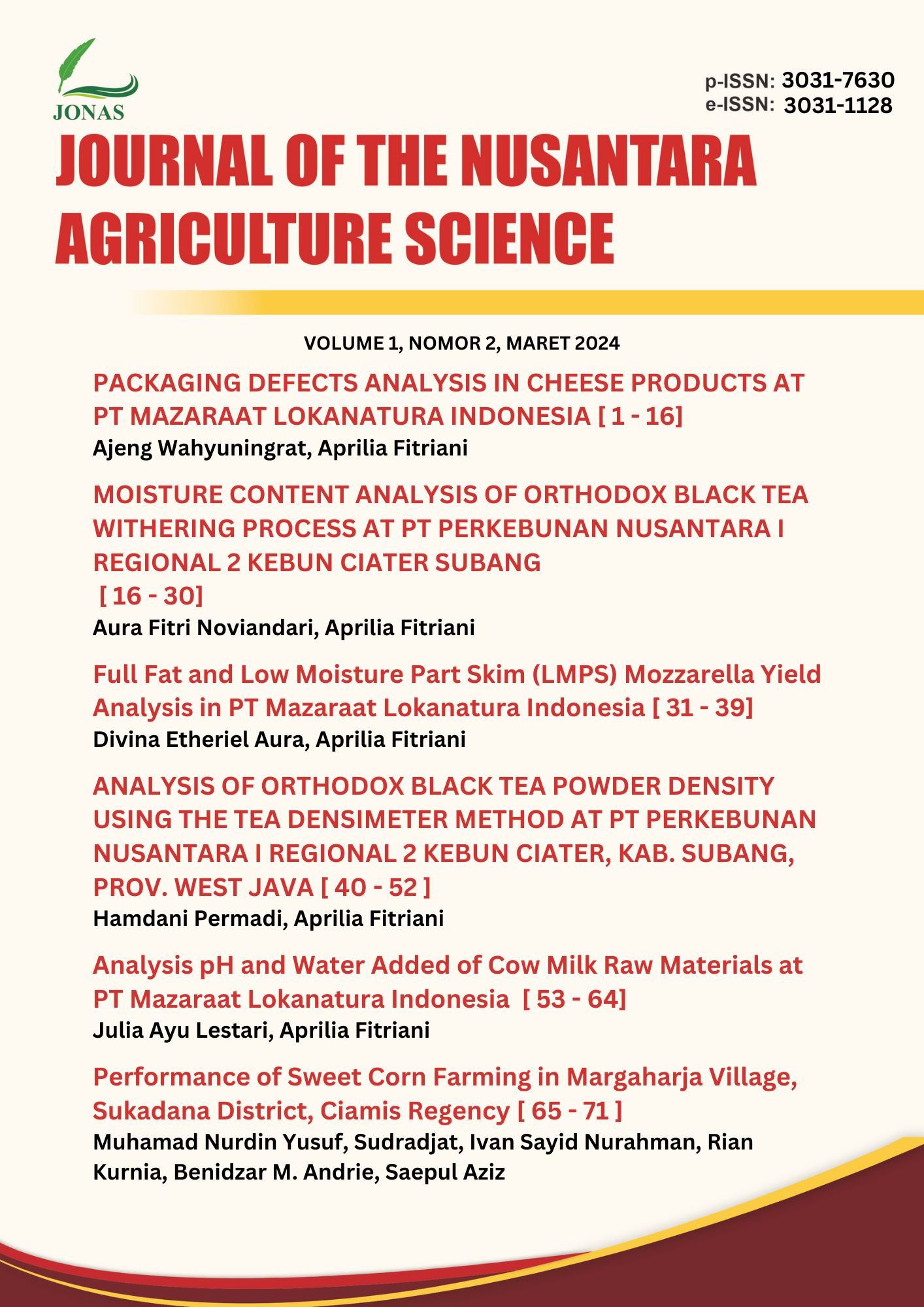
MOISTURE CONTENT ANALYSIS OF ORTHODOX BLACK TEA WITHERING PROCESS AT PT PERKEBUNAN NUSANTARA I REGIONAL 2 KEBUN CIATER SUBANG
Keywords:
Black tea, Fresh shoots, Moisture content, Orthodox system, Withered shootsAbstract
PT Perkebunan Nusantara I Regional 2 Ciater Garden is engaged in the black tea commodity using the orthodox system. In the production process, moisture content analysis is an important stage to control quality. Moisture content is the amount of water content that can affect the quality and stability of tea. This study aims to determine the results of the moisture content analysis of the orthodox black tea aging process, then determine the causal factors and impacts if there is a discrepancy in moisture content. The method used in analyzing the moisture content of orthodox black tea is the thermogravimetric method using the Halogen Moisture Analyzer. The test results at PT Perkebunan Nusantara I Regional 2 Ciater Garden showed that there were no deviations in the moisture content of fresh shoots and withered shoots of black tea. Success factors for tea testing include post-harvest management according to SOP, good weather, and appropriate raw materials. A mismatch in moisture content can be fatal. Too low moisture content results in fine tea powder and astringent taste, while too high moisture content results in uneven tea powder and bitter taste. Therefore, it is necessary to closely monitor the moisture content to ensure the quality of the tea produced.
References
Aaqil, M., Peng, C., Kamal, A., Nawaz, T., Zhang, F., & Gong, J. (2023). Tea Harvesting and Processing Techniques and Its Effect on Phytochemical Profile and Final Quality of Black Tea: A Review. Foods, 12(24), 1-28.
Ahmed, S., & Stepp, J. R. (2013). Green Tea: The Plants, Processing, Manufacturing and Production. Tea in Health and Disease Prevention, 19-31.
Andamdewi, R. R. (2018). Control of Biological, Chemical and Physical Hazards in the Black Tea Production Process in the Implementation of Haccp at PT Perkebunan Nusantara IX Kebun Semugih Pemalang Central Java Practical Work Report. Work Report, 1(1), 34-35.
Chan EWC, Soh EY, Tie PP, Law YP. 2011. Antioxidant and Antibacterial Properties of Green, Black, and Herbal Teas of Camellia Sinensis. Pharmacognosy Res 3: 266-272.
Deb, S., & Jolvis Pou, K. R. (2016). A Review of Withering in the Processing of Black Tea. Journal of Biosystems Engineering, 41(4), 365-372.
Hicks, A. (2009). Current Status and Future Development of Global Tea Production and Tea Products. Au Jt, 12(4), 251-264.
Kabir, S. M. S. (2016). Methods of Data Collection Basic Guidelines for Research: An Introductory Approach for All Disciplines (First Ed., Pp. 201-275).
Khikmawati, E., Wibowo, H., & Romadhona, R. F. (2021). Analysis of Water Quality Control Using X Control Map and R Control Map at PDAM Way Rilau Bandar Lampung. National Seminar on Industrial Engineering and Management, 1(1), 73-81.
Kumar, R. S. S., Murugesan, S., Kottur, G., & Gyamfi, D. (2013). Black Tea: Crops, Processing/Making and Production. In Tea in Health and Disease Prevention (Vol. 5). Academic Press London.
Kusumo, Y. P. J. (2010). Black Tea Processing Industry Pt. Pagilaran (Quality Control Section). Internship Report.
Ntezimana, B., Li, Y., He, C., Yu, X., Zhou, J., Chen, Y., Yu, Z., & Ni, D. (2021). Different Roasting Times Affect the Sensory Quality, Chemical Components, and Nutritional Characteristics of Black Tea. Foods (Basel, Switzerland), 10(11), 2627.
Pou, K. R. J., Paul, S. K., & Malakar, S. (2019). Industrial Processing of CTC Black Tea. In Caffeinated and Cocoa-based Beverages (Pp. 131-162). Elsevier.
Purba, P. S., Juanda, R., Abbas, T., & Andriyani, D. (2023). The Effect of Production and Land Area on Tea Exports in Indonesia. Unimal Journal of Agricultural Economics, 06(2), 30-40.
Putri, G. R., Lubis, R. F., & Yenita, A. (2021). Quality Control Analysis of Black Tea Water Content in the Tea Processing Industry. INVENTORY: E-Journal of Industrial Vocation in Agroindustry, 2(2), 81.
Qiao, D., Zhu, J., Mi, X., Xie, H., Shu, M., Chen, M., Li, R., Liu, S., & Wei, C. (2023). Effect of Fresh Leaf Steeping Time on the Formation of Flavor Quality of Taiping Houkui Tea. Lebensmittel-Wissenschaft Und Technologie [Food Science And Technology], 182(114833), 114833.
Ramanda, M. R., Nurjanah, S., & Widyasanti, A. (2021). Energy Audit of Black Tea Processing Process (Ctc) with Space Method Decision Making System. Journal of Agricultural Engineering, 10(2), 183.
Rosida, D.F., Amalia, D. (2015). Quality Control Study of Crushing, Tearing, Curling Black Tea. J.REKAPANGAN, 9(2), 59-73.
Salgueiro, L., Martins, A. P., & Correia, H. (2010). Raw Materials: The Importance of Quality and Safety. A Review. Flavor And Fragrance Journal, 25(5), 253-271.
Sari, D. N. I., Harisudin, M., & Khomah, I. (2022). Quality Control Analysis of Orthodox Black Tea Production at PT Perkebunan Nusantara VIII Rancabali Unit, Bandung Regency. Agrista, 10(4), 126-137.
Sejati, D. M. (2021). The Effect of Production Process and Quality of Raw Materials on Product Quality at Ketan Tape Business 38 Magelang. Thesis, 140(1), 6.
Shao, C., Zhang, C., Lv, Z., & Shen, C. (2021). Pre- and Post-Harvest Exposure to Stress Influence Quality-Related Metabolites in Fresh Tea Leaves (Camellia Sinensis). Scientia Horticulturae, 281(109984), 109984.
Sharma, M., Chawla, P., & Bains, A. (2023). Postharvest Processing of Tea: Techniques and Product Diversity. In Recent Advances in Spices, Medicinal and Plantation Crops.
Singgih, P. A., Halim, S., & Octavia, T. (2004). X Control Map with Varying Sample Size and Sampling Interval. Journal of Industrial Engineering, 2(2), 72-83.
Taherdoost, H. (2021). Data Collection Methods and Tools for Research; A Step-by-Step Guide to Selecting Data Collection Techniques for Academic and Business Research Projects. International Journal of Academic Research in Management (IJARM), 2021(1), 10-38.
Tamjidillah. 2005. Study of Variable Control Map Formation with Markov Chain Approach. Journal of Engineering Info. Vol. 6. No. 1. pp. (32 - 42).
Teshome, K. (2019). Effect of Tea Processing Method on Biochemical Composition and Sensory Quality of Black Tea (Camellia Sinensis (L.) O..Kuntze): A Review. Journal of Horticulture and Forestry, 11(6), 84-95.
Xu, Y. Q., Zhang, Y. N., Chen, J. X., Wang, F., Du, Q. Z., & Yin, J. F. (2018). Quantitative Analysis of Bitterness and Astringency of Catechins from Green Tea. Food Chemistry, 258(1), 16-24.
Yu, P. G., Yeo, A. S. L., Low, M. Y., & Zhou, W. B. (2014). Identification of Major Non-Volatile Compounds in Ready-to-Drink Green Tea and their Impact on Flavor Profile. Food Chemistry, 155, 9-16.
Yunitasari, L. (2015). Quality Control of Black Tea Processing at Tambi Plantation Unit, PT Tambi Plantation Wonosobo. In Universitas Sebelas Maret Press.
Yuwono, S. S., & Faustina, D. R. (2019). Effect of Withering Time and Chopping Size on Properties of Red Shoots (Syzygium Oleana) Herbal Tea. IOP Conference Series: Earth and Environmental Science, 230(1), 3-4.
Downloads
Published
How to Cite
Issue
Section
License
Copyright (c) 2024 Aura Fitri Noviandari, Aprilia Fitriani

This work is licensed under a Creative Commons Attribution 4.0 International License.